Scientific article · Sources checked October 21, 2026
Salicylic Acid and Skin Barrier Measurements in an Acne Trial With 31 Completers
A randomized split-face study found similar-looking four-week lesion reductions with two different topical treatments. Its paired design is informative, but the skin measurements answer narrower questions than claims about comfort, clearance, or pores.
Editorial source review, with no clinician sign-off or firsthand treatment experience claimed.
Counting acne lesions and measuring skin hydration are different ways of evaluating a topical treatment. A 28-day study brought those approaches together by comparing a modified salicylic acid cream with a benzoyl peroxide–adapalene gel on opposite sides of the same participants’ faces. Among 31 people who completed the trial, both facial sides had substantial reported lesion reductions. The between-side comparisons were not statistically significant, including comparisons of several skin measurements.
The useful story is not that every 2% salicylic acid product performs like a combination acne medicine. It is how a small paired study separates lesion counts from hydration, water loss, redness, and brightness—and where those measurements stop. This analysis uses the indexed primary report abstract and available official FDA material, alongside two related trial abstracts. The full split-face report was not accessible, so detailed protocols, statistical methods, and supplements were not examined.
In this article
Study facts at a glance
Population and design: Thirty-one participants completed a randomized, open-label, single-center, split-face trial involving mild to moderate acne; 31 completers do not represent 62 independent patients. Source 1
Treatments and duration: For 28 days, opposite facial sides received 2% supramolecular salicylic acid cream and 5% benzoyl peroxide plus 0.1% adapalene gel, according to the title and methods; the objective text inconsistently states 0.01% adapalene. Source 1
Total lesion results: Reported total lesion reductions were 44.1% with the salicylic acid cream and 45.6% with the comparator, without a statistically significant between-side difference. Source 1
Skin measurements: The abstract reports no statistically significant between-side differences in hydration, transepidermal water loss, brightness, or erythema indicators; this does not establish unchanged values over time. Source 1
Safety boundary: Detailed adverse-event frequencies were unavailable in the trial abstract. FDA separately distinguishes ordinary local irritation from rare serious hypersensitivity associated with some OTC acne products. Source 1 Source 6
One face, two treatments, one paired comparison
Participants had mild to moderate acne. Investigators randomly assigned 2% supramolecular salicylic acid cream to one facial side and the benzoyl peroxide–adapalene gel to the opposite side. Lesions and side effects were evaluated at baseline, day 14, and day 28. Skin water content, water loss, and color-related indexes were measured at the same visits.
A split-face design makes each person their own comparison. Age, much of the hormonal environment, and many everyday exposures are shared across the two sides. That can reduce some between-person variability. It does not guarantee identical baseline lesion counts on both sides, and the accessible abstract does not provide those starting counts.
The unit of interpretation remains the participant with two linked observations. Thirty-one completers supplied paired facial-side information, not 62 independent patient experiences. The abstract does not state the original enrollment denominator, so neither a completion percentage nor an attrition rate can be calculated. It also does not clearly designate a single primary endpoint among the reported measurements.
Read the underlying chart data: download CSV or download the source-labeled chart.
The formulation matters as much as the percentage
The experimental cream contained supramolecular salicylic acid, described in the report as a modified preparation. The comparator was a gel containing two active drugs: 5% benzoyl peroxide and, according to the title and methods, 0.1% adapalene. These concentrations identify study arms; they are not instructions for assembling or using a regimen.
There is a genuine reporting inconsistency. The objective text gives adapalene as 0.01%, while the title, methods, and combination notation identify 0.1%. The most transparent reading is to attribute 0.1% to those sections while preserving the discrepancy. Without the full report, it cannot be independently resolved.
Cream versus gel also means the comparison was not simply salicylic acid molecules versus two other molecules in an identical base. The trial compares complete preparations. Its results therefore do not automatically transfer to ordinary salicylic acid serums, washes, compounded creams, or other delivery routes. The guide to face cream versus acne cleanser develops that format distinction without treating matching percentages as matching evidence.
Reading the lesion reductions without turning them into clearance
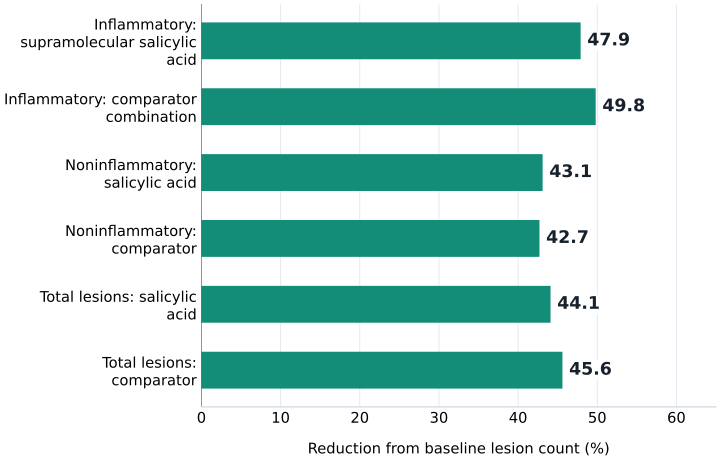
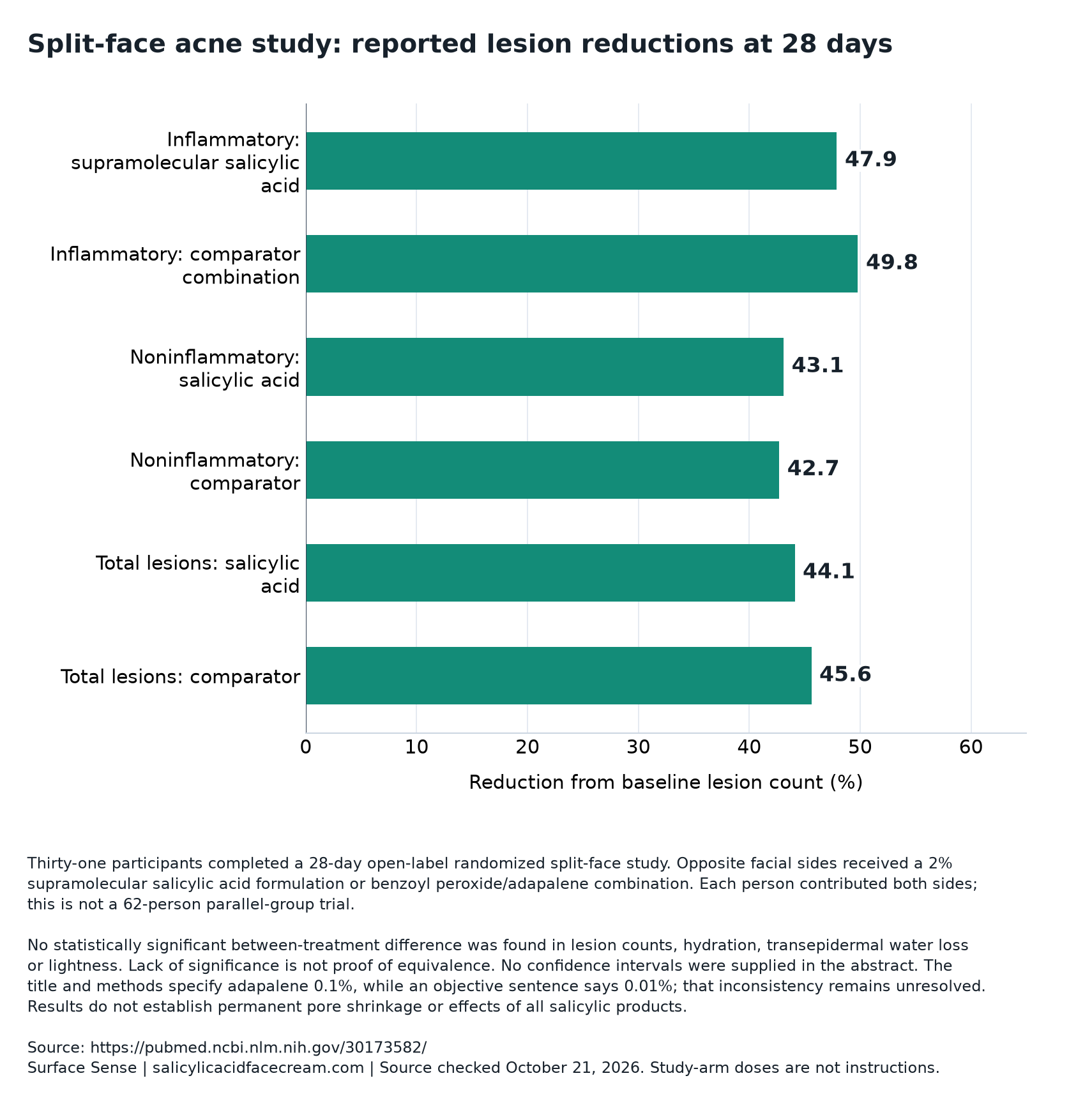
At day 28, reported reductions were close across the three lesion categories. Inflammatory lesions were papules and pustules; noninflammatory lesions were counted separately. Total lesions combined the categories. The abstract reports group-level percentages without specifying whether they are means, medians, or another summary, so they should not be relabeled as averages.
The percentage-point gaps below are simple subtraction, not additional trial outcomes. The salicylic acid side had a 1.9-percentage-point smaller inflammatory reduction and a 1.5-point smaller total reduction, while its noninflammatory reduction was 0.4 points larger. None of these between-side comparisons was statistically significant.
For scale only, a hypothetical facial side starting with 50 lesions and declining by 44% would finish with about 28. That example illustrates why a sizable percentage reduction is not the same as clear skin. It is not a reconstruction of these participants’ counts: their baselines, individual responses, and number achieving clearance are unavailable.
Reported day-28 lesion reductions; percentage-point differences are arithmetic comparisons, not adjusted estimates.
| Lesion category | 2% supramolecular salicylic acid | 5% benzoyl peroxide plus 0.1% adapalene |
|---|---|---|
| Inflammatory | 47.9% reduction | 49.8% reduction; 1.9 percentage points larger |
| Noninflammatory | 43.1% reduction | 42.7% reduction; 0.4 percentage points smaller |
| Total | 44.1% reduction | 45.6% reduction; 1.5 percentage points larger |
Why a nonsignificant difference is not equivalence
The abstract reports that all three day-28 lesion comparisons had p-values greater than 0.05. This means the reported testing did not establish a statistically significant difference between treatments. It does not prove that the treatments have the same effect, nor does it establish that any difference is too small to matter clinically.
Formal equivalence or noninferiority requires a defined acceptable difference and an analysis designed to assess it. Those details are not available in the abstract. Confidence intervals are also absent, so readers cannot see how wide a range of between-treatment differences remains compatible with these data. Closely spaced point results alone cannot supply that missing precision.
The paired design can improve efficiency, but its benefit depends partly on how strongly the two sides’ responses track within individuals. Full statistical methods would be needed to judge how that pairing was handled. The defensible conclusion is preliminary evidence of comparable-looking short-term reductions, not a demonstrated interchangeable alternative.
Hydration and water loss measure different things
Skin water content concerns hydration. Transepidermal water loss, abbreviated TEWL, measures water passing outward through the skin and is used to assess barrier-related behavior. These outcomes are related but not interchangeable: a hydration reading does not by itself describe the entire barrier, and a water-loss reading is not a direct measure of how comfortable skin feels.
The study found no statistically significant between-side differences in the hydration and TEWL measurements. That result concerns the contrast between treatments. Both sides could have changed in a similar direction, or the study could have lacked precision to identify a difference. Without the actual values and changes, it is incorrect to say hydration stayed constant or that neither treatment affected the barrier.
This distinction matters when acne and dryness coexist. Lesion improvement need not establish improved hydration, and similar instrument readings need not establish equal subjective dryness. The guide to salicylic acid products when skin feels dry provides a separate product-comparison framework; it should not be mistaken for confirmation that those products reproduce this trial.
Brightness and redness are not pore measurements
The study also recorded L* and a* values, color-related measures described in the abstract as brightness and erythema indicators. Their between-side differences were not statistically significant. These findings do not establish an improvement in pigmentation, a lack of visible irritation, or identical cosmetic appearance for every participant.
Most importantly, lesion counts are not measurements of pore diameter. A decline in noninflammatory lesions cannot be converted into a percentage reduction in visible pore size. The abstract does not report pore imaging, permanent pore changes, scar outcomes, or patient-reported satisfaction with texture.
FDA’s acne monograph addresses acne lesions, blackheads, and whiteheads, rather than permanent pore shrinkage. Its cosmetic BHA page likewise does not supply a precise pore-size or wrinkle benefit. The ingredient-claims guide for a multicomponent cream is useful for keeping whole-formula claims separate from evidence about one acne active.
What open-label observation leaves unresolved
This trial was randomized but open-label. Random assignment of facial sides helps protect the comparison from systematic allocation choices; it does not blind participants or investigators to treatment. Knowledge of the assigned preparation could influence reporting or assessment. Counting lesions is more structured than a general impression, but it still requires classification and observation.
Instrument measurements add another kind of evidence, not immunity from methodological concerns. Their interpretation would benefit from information about measurement conditions, repeat readings, baseline balance, and analysis procedures. Those details are not available in the indexed abstract, so no particular measurement failure should be assumed—but measurement rigor cannot be fully assessed either.
Follow-up lasted only four weeks at one center. That supports a short-term question, not conclusions about recurrence, sustained control, or long-term tolerability. Participant ages, detailed demographic characteristics, funding, and sponsor information were not available in the accessed abstract. Those gaps limit evaluation of generalizability and potential conflicts without establishing that either was problematic.
Two other trials answer different salicylic acid questions
A separate 12-week double-blind randomized study involved 37 volunteers and compared a cream combining 0.5% chloroxylenol with 2% salicylic acid against 5% benzoyl peroxide gel. Reported inflammatory and noninflammatory reductions were numerically close. Between-group differences were not statistically significant, while erythema and photosensitivity were reported as significantly less frequent with the combination at week 12.
Another 12-week randomized, single-blind trial enrolled 49 patients and tested adding salicylic acid to clindamycin plus benzoyl peroxide. Lesion outcomes favored the added-salicylic-acid regimen, but the abstract supplies no effect sizes or confidence intervals. Both groups had significantly reduced stratum corneum hydration, and transient mild to moderate dryness was significantly more frequent with added salicylic acid.
These studies should not be pooled informally into a claim about salicylic acid alone. One tested a chloroxylenol combination; another tested an addition to an antibiotic-containing regimen. The companion analysis of the combination-cream trial examines the first comparison in detail. Together, the reports show why efficacy and comfort depend on the actual regimen being tested.
Three randomized trials, three distinct treatment comparisons; participant counts refer to different reported populations.
| Study and reported population | Comparison and duration | Interpretive boundary |
|---|---|---|
| Split-face trial: 31 completers | 2% modified salicylic acid cream versus benzoyl peroxide–adapalene gel; 28 days | Paired short-term comparison; no significant between-side lesion differences |
| Combination-cream trial: 37 volunteers | Chloroxylenol plus salicylic acid cream versus benzoyl peroxide gel; 12 weeks | Cannot isolate salicylic acid; fewer reported erythema and photosensitivity events at week 12 |
| Addition trial: 49 enrolled | Salicylic acid added to clindamycin plus benzoyl peroxide versus that combination alone; 12 weeks | Lesion outcomes favored addition, but transient dryness was more frequent |
Safety needs more than a similar redness reading
Investigators evaluated side effects in the split-face study, but the abstract does not give detailed adverse-event counts, severity categories, or treatment discontinuations. Its nonsignificant erythema comparison cannot substitute for that information. A 31-completer, four-week experience is also poorly suited to identifying uncommon reactions.
FDA warns that some OTC acne products containing salicylic acid or benzoyl peroxide have been associated with rare serious hypersensitivity, distinct from ordinary dryness or local irritation. The responsible ingredient may be active, inactive, or a combination; it was not established. The agency advises stopping the product and seeking emergency care for throat tightness, breathing difficulty, faintness, or swelling of the eyes, face, lips, or tongue.
The historical FDA review included 131 reports, 58 involving hospitalization and 50 categorized as anaphylactic. These are selected reports without a user-exposure denominator, not incidence rates. Separately, the acne monograph warns of increased irritation and dryness when topical acne medicines are combined. Neither a short trial nor a preliminary sensitivity check guarantees freedom from a later reaction.
From a research cream to a product decision
FDA’s topical acne monograph lists salicylic acid at 0.5–2% and benzoyl peroxide at 2.5–10%, subject to all applicable conditions. That regulatory framework is not product-specific approval and does not demonstrate that every conforming product performs like this research cream. A matching active percentage cannot establish matching delivery, tolerability, or clinical results.
Editorial interpretation: the practical purchasing question is whether a product’s documented formulation and terms fit the reader’s needs, not whether a study percentage can be attached to its advertising. The CoreAge Rx review and Likeness Rx review can be used to check documented product and service terms. Neither link implies that the provider offers the studied preparation or reproduces its outcomes.
The next useful study would extend follow-up, report baseline counts and paired confidence intervals, specify a primary endpoint, and provide complete adverse-event data. A predefined equivalence question would require its own margin and analysis. Direct measurements would also be necessary before extending the evidence to pores, scarring, or long-term comfort.
Questions about the evidence
Were there 31 patients or 62 patients?
The abstract reports 31 completers. Each contributed two facial sides, but those sides are linked observations within one person, not independent patients. The original enrollment count is unavailable, so the number who withdrew and the completion rate cannot be determined.
Did salicylic acid work as well as adapalene plus benzoyl peroxide?
The reported reductions were numerically close, and the between-side differences were not statistically significant. That supports further investigation, not formal equivalence. The abstract provides neither confidence intervals nor a predefined equivalence margin, so it cannot establish how much difference has been ruled out.
Does no hydration difference mean neither treatment dried the skin?
No. A comparison between sides is different from a comparison with baseline. Both sides could have changed similarly. Hydration and TEWL also do not fully capture subjective tightness, stinging, or dryness. Detailed adverse-event frequencies and longitudinal measurement values were not available in the abstract.
Can an ordinary 2% salicylic acid cleanser claim these results?
This trial tested a modified salicylic acid cream, not a rinse-off cleanser. Matching concentration alone does not establish matching formulation or performance. FDA’s monograph sets conditions for OTC acne products, but it does not transfer one preparation’s clinical findings to every product with the same active percentage.
Did the study show that pores permanently became smaller?
No pore-size endpoint is reported. Noninflammatory lesion reduction is an acne finding, not a direct measure of pore dimensions or permanence. Neither the FDA acne monograph nor its cosmetic BHA background page supplies the missing evidence for a precise permanent pore-shrinkage claim.
What this evidence supports
This pilot trial offers a useful paired observation: after 28 days, two specific topical preparations produced close reported lesion reductions in 31 completers, without statistically significant between-side differences in lesion or selected skin measurements. Its strongest contribution is the combination of acne counting and barrier-related assessment within the same people. Its weakest use would be as proof of equivalence, universal tolerability, or permanent pore improvement. Larger, longer studies with transparent paired estimates and complete safety reporting are needed to turn the preliminary comparison into a more precise clinical conclusion.
Research access and limitations
The clinical analysis relies on indexed primary abstracts rather than full trial reports. For the split-face study, original enrollment, confidence intervals, detailed adverse-event frequencies, full statistical methods, funding, and sponsor information were unavailable. The adapalene concentration discrepancy is unresolved. Official FDA materials supply regulatory and safety context, not additional efficacy findings.
Sources behind this reading
- Efficacy and safety of 2% supramolecular salicylic acid compared with 5% benzoyl peroxide/0.1% adapalene in the acne treatment: a randomized, split-face, open-label, single-center study. ↗Indexed primary study abstract · Checked October 21, 2026
- FDA OTC monograph M006: topical acne drug products ↗Official six-page administrative order, all sections read · Checked October 21, 2026
- FDA: beta hydroxy acids in cosmetics ↗Official FDA consumer background page, complete text read · Checked October 21, 2026
- Comparison of chloroxylenol 0.5% plus salicylic acid 2% cream and benzoyl peroxide 5% gel in the treatment of acne vulgaris: a randomized double-blind study. ↗Indexed primary study abstract · Checked October 21, 2026
- Efficacy of the addition of salicylic acid to clindamycin and benzoyl peroxide combination for acne vulgaris. ↗Indexed primary study abstract · Checked October 21, 2026
- FDA safety communication: serious hypersensitivity to some OTC acne products ↗Official FDA Spanish communication; entire safety notice and data summary read · Checked October 21, 2026