Scientific article · Sources checked October 21, 2026
Salicylic Acid Acne Cream: Lesion Reduction and Skin Comfort Are Separate Outcomes
A 37-person trial compared a chloroxylenol–salicylic acid cream with benzoyl peroxide gel. Its findings support a narrow formulation comparison—not equivalence, a salicylic-acid-only effect, or proof of a stronger skin barrier.
Editorial source review, with no clinician sign-off or firsthand treatment experience claimed.
An acne treatment can reduce blemish counts without improving every aspect of skin condition. Redness, dryness, water content, and water loss are different outcomes, and a favorable result for one does not settle the others. That distinction matters in a small randomized trial comparing a cream containing chloroxylenol 0.5% plus salicylic acid 2% with benzoyl peroxide 5% gel. After 12 weeks, the two groups had closely spaced reported lesion reductions, while some tolerability findings favored the cream.
The interesting question is not simply which ingredient won. The study compared two complete formulations, used only 37 volunteers, and did not establish formal equivalence. Two related trials add useful context: one tested salicylic acid added to an antibiotic-containing regimen, and another compared treatments on opposite sides of the face. This analysis uses their indexed primary report abstracts and available official FDA material, rather than claiming examination of full protocols or supplements.
In this article
Study facts at a glance
Main trial: A randomized, double-blind, 12-week study assigned 19 volunteers to benzoyl peroxide 5% gel and 18 to chloroxylenol 0.5% plus salicylic acid 2% cream. Source 1
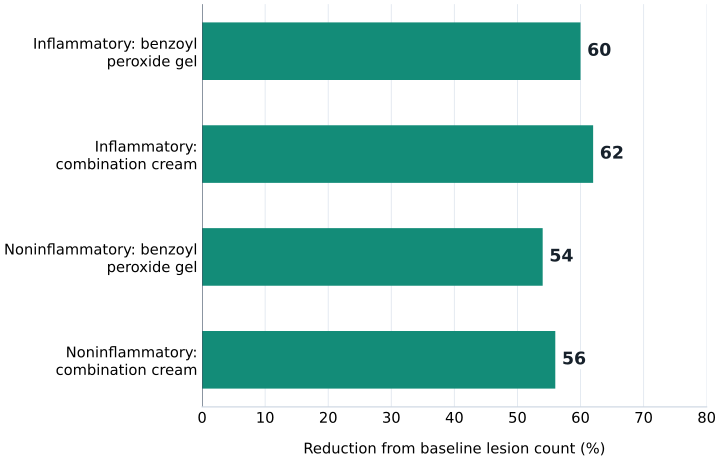
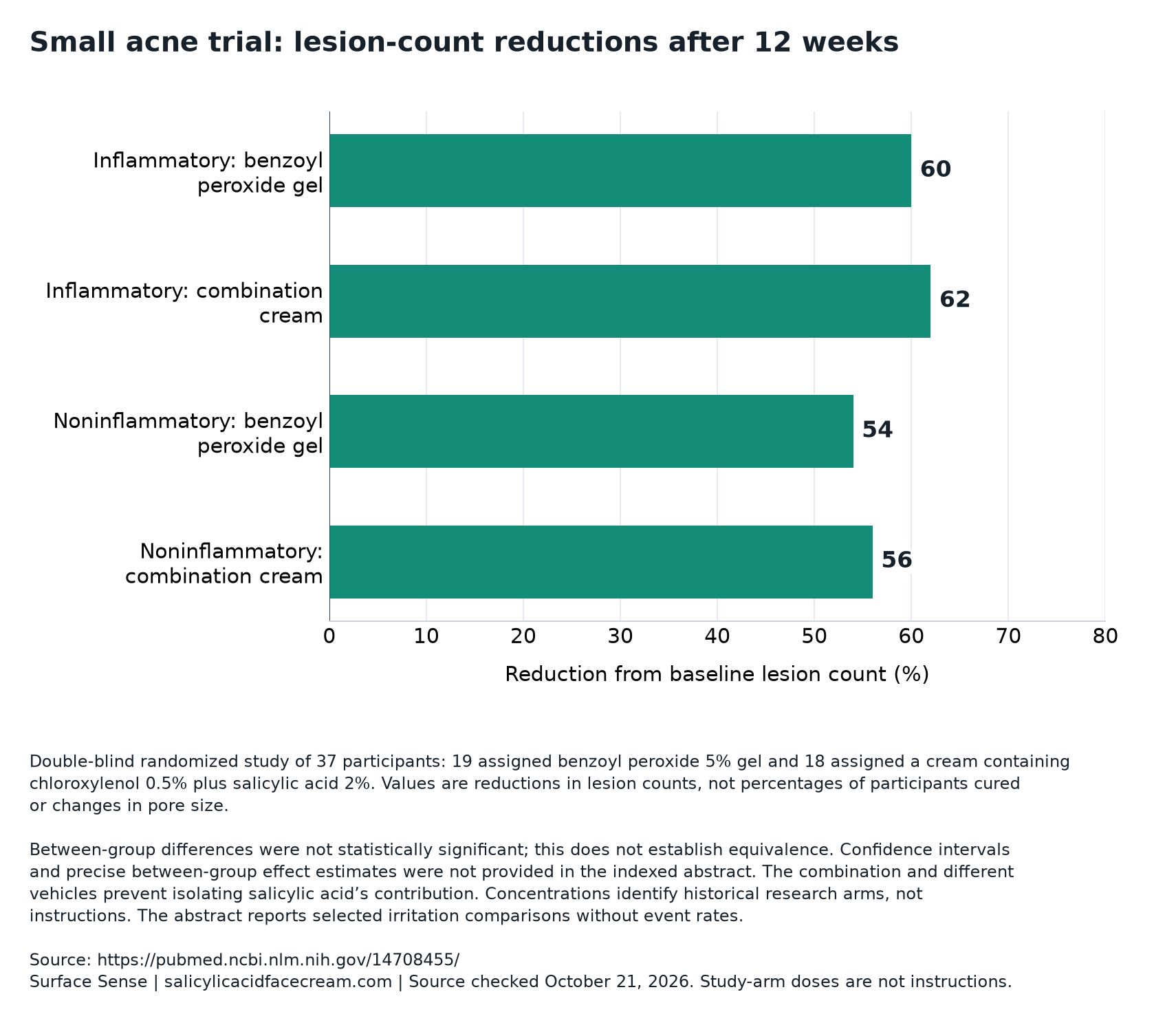
Reported lesion reductions: Inflammatory lesions fell 60% with benzoyl peroxide and 62% with the combination; noninflammatory lesions fell 54% and 56%, respectively. Source 1
Statistical boundary: Between-group lesion-count differences were not statistically significant. The abstract does not provide confidence intervals or establish formal equivalence. Source 1
Tolerability signal: Week-12 erythema and photosensitivity findings favored the combination cream, but the abstract gives no event frequencies from which to calculate an absolute risk difference. Source 1
Regulatory context: FDA's OTC acne monograph includes salicylic acid at 0.5–2%, but matching that concentration is not individual product approval or proof of the same clinical performance. Source 2
What the 37-person trial actually compared
The central study was a 12-week randomized, double-blind comparison of two topical acne treatments. Nineteen volunteers received benzoyl peroxide 5% gel; 18 received a cream containing chloroxylenol 0.5% and salicylic acid 2%. Participants applied their assigned medication to the entire face twice daily. Those concentrations and application details identify the research arms; they are not instructions for assembling or using a personal regimen.
Investigators performed clinical evaluations and lesion counts at baseline and weeks 3, 6, 9, and 12. Repeated visits can describe the course of response, but the indexed abstract supplies its clearest numerical results at week 12. It does not identify a single prespecified primary endpoint or provide detailed baseline severity, age distribution, adherence, withdrawals, or sponsor information. Those missing details limit assessment of balance between groups and the completeness of follow-up.
Randomization helps make treatment groups comparable, while double-blinding aims to reduce expectation-driven differences in reporting and assessment. Neither feature makes a small study definitive. The abstract also does not explain how masking was maintained when comparing a cream with a gel, so the success of blinding cannot be independently assessed.
Read the underlying chart data: download CSV or download the source-labeled chart.
Reading the lesion reductions without turning them into clearance
At week 12, reported inflammatory-lesion reductions were 60% for benzoyl peroxide and 62% for the combination cream. Inflammatory lesions include papules and pustules. Reported noninflammatory-lesion reductions, referring to comedones such as blackheads and whiteheads, were 54% and 56%. Because the abstract does not specify the summary statistic behind these percentages, they should be described as group-level results rather than means or medians.
Each numerical separation is two percentage points. For illustration only, if two hypothetical groups each started with 50 inflammatory lesions under the same counting convention, reductions of 60% and 62% would correspond to 20 and 19 remaining lesions. That arithmetic illustrates scale; it does not reconstruct the trial's baseline counts or establish a one-lesion benefit in actual participants.
A percentage reduction in lesions is not the percentage of people who became clear. The report does not provide a clearance rate, a threshold for treatment success, or an individual response distribution. It therefore cannot tell readers how many participants had little improvement, substantial improvement, or no visible acne at the end.
Week-12 group-level lesion reductions in the main trial
| Lesion category | Benzoyl peroxide 5% gel | Chloroxylenol 0.5% + salicylic acid 2% cream |
|---|---|---|
| Inflammatory lesions | 60% reduction | 62% reduction |
| Noninflammatory lesions | 54% reduction | 56% reduction |
| Between-group interpretation | No statistically significant difference reported | No statistically significant difference reported |
Close results are not a formal equivalence finding
The investigators reported no statistically significant between-group difference in reductions of papules/pustules or comedones. That means the analysis did not demonstrate a difference under its statistical criteria. It does not prove that the treatments have identical effects, nor that any true difference must be too small to matter.
A formal equivalence study needs a justified boundary defining how different the treatments may be while still counting as equivalent, along with sufficiently precise estimates. The accessible abstract provides neither an equivalence margin nor confidence intervals for the treatment difference. With only 19 and 18 participants in the arms, precision is an important unresolved issue, but its magnitude cannot be calculated from the reported percentages alone.
The authors characterized the cream favorably, yet the more defensible public-facing conclusion is narrower: both groups improved, their reported reductions were close, and superiority was not demonstrated for lesion counts. These are percentage changes in counts, not hazard ratios, risk ratios, or patient-level success probabilities. Translating them into a number needed to treat would require outcomes the report does not supply.
The cream tested a combination, not salicylic acid alone
The experimental cream contained both chloroxylenol and salicylic acid. Without a salicylic-acid-only arm, a chloroxylenol-only arm, or a matched vehicle control, the study cannot separate their contributions. It also cannot determine whether the ingredients interacted or whether the cream base contributed to differences in comfort.
The comparator was a benzoyl peroxide gel, not the same cream base containing another active ingredient. This makes the study useful as a comparison of finished treatment packages, but less useful for assigning causality to one molecule. Texture, vehicle ingredients, active ingredients, and their combined delivery all changed between arms.
That distinction becomes practical when comparing modern products. A leave-on cream cannot automatically stand in for a rinse-off wash, an oral treatment, a compounded preparation, or another 2% salicylic acid product. The guide to face creams versus acne cleansers develops the format question, while the ingredient-claims guide helps separate a whole formula from claims about individual components.
The tolerability findings need event counts
At week 12, the abstract reports significantly fewer erythema and photosensitivity adverse effects with the combination cream. Erythema means redness. The reported P values were 0.0002 for erythema and 0.05 for photosensitivity. These findings support a tolerability signal favoring that formulation for those specific outcomes at that assessment.
A P value is not an adverse-event rate. It does not mean that 0.02% or 5% of participants experienced an event, and it does not reveal the size of the difference. Without event frequencies, severity distributions, and information about the analysis, readers cannot calculate the percentage of participants affected or an absolute reduction in adverse effects.
The result also does not establish that the cream improved hydration or repaired the skin barrier: those are different measurements, not reported here. For readers comparing acne control with comfort, the dryness-focused product guide offers a useful framework, but this trial cannot rank the tolerability of products it never tested.
Adding salicylic acid produced a different benefit–dryness pattern
A separate 12-week prospective, randomized, single-blind study enrolled 49 patients with mild to moderate facial acne. It compared salicylic acid added to clindamycin plus benzoyl peroxide with clindamycin plus benzoyl peroxide alone. This asks an addition question: whether an extra treatment improves an existing regimen. It does not compare salicylic acid alone against benzoyl peroxide.
The added-salicylic-acid group had statistically greater reductions in inflammatory and total lesions throughout the reported study weeks, and in noninflammatory lesions beyond two weeks. Patient and investigator global-improvement scores also favored the addition at the end. However, the abstract supplies no numerical treatment effects or confidence intervals, and does not state the salicylic acid concentration, preventing a quantitative comparison with the 37-person trial.
Both regimens significantly decreased stratum corneum hydration—the water content of the outer skin layer. The salicylic-acid addition also reduced measured sebum and produced more mild to moderate transient dryness. Better lesion control therefore coexisted with a comfort cost. The antibiotic-containing regimen also belongs in a professional treatment context, not a do-it-yourself combination inferred from the abstract.
Why the paired-face study is informative but not interchangeable
Another randomized study assigned 2% supramolecular salicylic acid cream to one facial side and benzoyl peroxide/adapalene gel to the other for 28 days. Thirty-one patients completed this single-center, open-label trial. Pairing sides helps control person-level influences because both sides share the same individual. It does not create 62 independent patients, and the enrollment denominator and attrition are unavailable in the abstract.
Reported day-28 reductions were 47.9% versus 49.8% for inflammatory lesions, 43.1% versus 42.7% for noninflammatory lesions, and 44.1% versus 45.6% for total lesions, with no statistically significant between-side differences. These short-term findings do not establish equivalence. Open-label assessment can also leave room for expectations to influence lesion classification or symptom reporting.
The title and methods identify the comparator as 5% benzoyl peroxide plus 0.1% adapalene, but the objectives also contain a 0.01% adapalene reference. That discrepancy remains unresolved without independent full-paper confirmation. Supramolecular salicylic acid is a modified formulation, not the chloroxylenol combination. Our paired-face study analysis examines that design in greater detail.
Three studies answer three different treatment questions
| Study population and duration | Comparison | Main interpretive boundary |
|---|---|---|
| 37 volunteers; 12 weeks | Chloroxylenol–salicylic acid cream versus benzoyl peroxide gel | Cannot isolate salicylic acid or establish equivalence |
| 49 enrolled patients; 12 weeks | Salicylic acid added to clindamycin–benzoyl peroxide versus that regimen alone | Better reported lesion outcomes accompanied by more transient dryness |
| 31 completers; 28 days | Opposite facial sides receiving modified salicylic acid or benzoyl peroxide/adapalene | Paired, open-label pilot; not 62 independent patients |
Hydration, water loss, and redness answer separate questions
The paired-face trial measured skin water content and transepidermal water loss, or TEWL: water passing outward through the skin. Hydration concerns the amount of water present; TEWL concerns water movement. Neither is simply another name for lesion count, and a change in one does not establish a matching change in the other.
At the reported assessments, the trial found no statistically significant between-side differences in hydration, TEWL, brightness, or erythema indicators. This is not evidence that each measurement stayed unchanged from baseline. Both sides could change similarly over time without creating a detectable difference between treatments. The abstract does not provide enough numerical detail to reconstruct those trajectories.
These instrument readings also do not establish an absence of irritation, permanent pore-size reduction, scar improvement, or long-term safety. The addition trial's decreased hydration and increased dryness further show why efficacy and barrier-related outcomes should be evaluated separately. Acne control and comfort can move in different directions within the same regimen.
FDA acne rules do not certify a matching modern formula
FDA's OTC topical acne monograph lists salicylic acid at 0.5–2% and benzoyl peroxide at 2.5–10%. These are parts of a regulatory framework with other applicable conditions, including labeling. A product's concentration matching that range does not make it individually FDA-approved, demonstrate compliance with every condition, or transfer the clinical results of a different formulation.
The monograph addresses acne lesions, blackheads, and whiteheads; it does not establish permanent pore-size change. FDA's separate BHA cosmetics page discusses salicylic acid and exfoliation, but cosmetic background information is not a new acne trial. Its historical discussion of safety research should not be presented as a verified current research program or product-specific endorsement.
Editorial interpretation: purchase and service decisions should keep evidence, formula identity, and contractual terms in separate columns. Readers considering a service can check documentary terms in the CoreAge Rx review or Likeness Rx review. Neither link establishes that a provider supplies the studied formulation, offers condition-specific care, or reproduces these outcomes.
Safety signals extend beyond ordinary dryness
FDA labeling context warns that combining topical acne medicines can increase irritation and dryness. Benzoyl peroxide carries additional warnings involving sensitivity, sunlight, eye or mucosal contact, and fabric bleaching. These details are reasons to read the actual product label rather than convert a research schedule into personal instructions.
Rare serious hypersensitivity is different from ordinary local irritation. FDA's historical safety communication described 131 reports through January 28, 2013, including 58 hospitalizations and 50 classified as anaphylactic. Those selected reports have no exposure denominator and cannot yield an incidence rate. The responsible ingredient was not established: active ingredients, inactive ingredients, or both could have contributed.
FDA advises stopping the product and seeking emergency care for throat tightness, breathing difficulty, faintness, or swelling of the eyes, face, lips, or tongue. Small-area sensitivity checks do not guarantee freedom from later allergy. These warnings neither erase the trial's tolerability findings nor allow a 37-person study to exclude uncommon serious reactions.
Questions about the evidence
Did the combination cream beat benzoyl peroxide?
Not on the reported lesion-count comparison. The cream's reductions were numerically two percentage points greater in both lesion categories, but the between-group differences were not statistically significant. Some week-12 tolerability findings favored the cream. Efficacy superiority and tolerability advantages are separate conclusions.
Does a 62% reduction mean 62% of participants cleared?
No. It describes the reported group-level reduction in inflammatory lesions, not the proportion of participants without acne. The abstract does not provide patient-level clearance rates or enough information to infer them. A substantial reduction can still leave lesions present.
Can these findings be applied to any 2% salicylic acid product?
No. The main trial tested a chloroxylenol-containing cream, while the paired-face study tested a modified supramolecular formulation. Neither establishes identical results for another cream, serum, cleanser, compounded product, or route. Ingredient percentage alone does not reproduce the full treatment tested.
Did the paired-face study show that the skin barrier never changed?
No. It reported no statistically significant differences between facial sides in hydration and TEWL. That does not establish unchanged values over time or exclude changes shared by both sides. Detailed numerical trajectories and confidence intervals were unavailable in the indexed abstract.
What additional evidence would most improve confidence?
Larger studies with clear endpoint priorities, confidence intervals, complete adverse-event counts, and longer follow-up would improve interpretation. Matched vehicles and separate ingredient arms could distinguish salicylic acid's contribution from chloroxylenol and the base. Better reporting of masking, withdrawals, and patient-reported comfort would also clarify the findings.
What this evidence supports
The strongest conclusion is formulation-specific: a small randomized trial found substantial reported lesion reductions with both treatments and selected tolerability advantages for chloroxylenol–salicylic acid cream. It did not establish equivalence or isolate salicylic acid's effect. The related studies reinforce a more useful distinction than a simple ingredient ranking: lesion reduction, hydration, water loss, and subjective dryness are separate outcomes. A treatment may perform favorably on one while offering no demonstrated advantage—or a disadvantage—on another.
Research access and limitations
The clinical analysis relies on indexed primary report abstracts, not full protocols, supplements, or independently reviewed full articles. Confidence intervals, detailed adverse-event frequencies, sponsor information, and several design details were unavailable in those abstracts. Official FDA documents supply regulatory and safety context, not product-specific clinical validation.
Sources behind this reading
- Comparison of chloroxylenol 0.5% plus salicylic acid 2% cream and benzoyl peroxide 5% gel in the treatment of acne vulgaris: a randomized double-blind study. ↗Indexed primary study abstract · Checked October 21, 2026
- FDA OTC monograph M006: topical acne drug products ↗Official six-page administrative order, all sections read · Checked October 21, 2026
- Efficacy of the addition of salicylic acid to clindamycin and benzoyl peroxide combination for acne vulgaris. ↗Indexed primary study abstract · Checked October 21, 2026
- Efficacy and safety of 2% supramolecular salicylic acid compared with 5% benzoyl peroxide/0.1% adapalene in the acne treatment: a randomized, split-face, open-label, single-center study. ↗Indexed primary study abstract · Checked October 21, 2026
- FDA: beta hydroxy acids in cosmetics ↗Official FDA consumer background page, complete text read · Checked October 21, 2026
- FDA safety communication: serious hypersensitivity to some OTC acne products ↗Official FDA Spanish communication; entire safety notice and data summary read · Checked October 21, 2026